Executive Summary
Revenue is seductive. It is visible, measurable, and celebrated by management teams, investors, boards, and markets. Revenue growth suggests momentum. It signals customer demand. It gives the appearance of progress.
But revenue can deceive.
It does not reveal whether a company can deliver value efficiently or generate sustainable cash flow. Companies are not financed, valued, or acquired based on revenue alone — they are valued based on their ability to generate future cash flow.
Financial scorecards — COGS, gross margin, operating expenses, net income, EBITDA, etc. — show outcomes. Operating Architecture™ sits beneath those outcomes. It is the underlying system of activities, workflows, decisions, costs, handoffs, and delivery that determines whether revenue becomes cash flow efficiently or gets consumed by complexity.
Yet most organizations invest heavily in growing revenue while paying far less attention to the operating design required to convert that growth into cash.
The Operating Architecture™ Framework was built to close that gap — a practical methodology, drawn from decades of experience as a founder, operator, Investment Banker, investor, board member, and advisor, for converting demand into sustainable cash flow, enterprise value, and shareholder returns.
The purpose is not simply to reduce cost. It is to build businesses that scale with less friction, expand operating leverage, generate stronger cash flow, improve long-term enterprise value, and increase shareholder returns.
As discussed later in this paper, a medical second-opinion company shows how Operating Architecture™ can move beyond operational improvement to business-model redesign. By understanding value delivery and actual delivery economics, the company uncovered the ability to disrupt the industry's legacy pricing model.
Introduction
Over time, the consequences compound. Processes become layered. Costs become embedded. Systems are added. Manual workarounds become permanent. Growth becomes more difficult, more expensive, and less profitable.
The company may still be growing. But somewhere between market demand and sustainable cash flow, value is leaking. That space — between what a business earns and what it actually converts — is the Conversion Gap. And most organizations never see it clearly until it is too late.
After decades of building companies, raising capital, advising management teams, and reengineering operations, I arrived at a simple conclusion:
That principle became the foundation of the Operating Architecture™ Framework — a business design methodology created to help organizations understand how value is delivered, what it truly costs to deliver that value, and how to build an operating platform capable of converting demand into cash flow, enterprise value, and shareholder returns.
This paper is written for founders, operators, investors, and boards who want to understand not just how businesses grow — but how they are built to last.
Every business has an operating architecture.
Some are intentionally designed. Many simply evolve.
The difference matters.
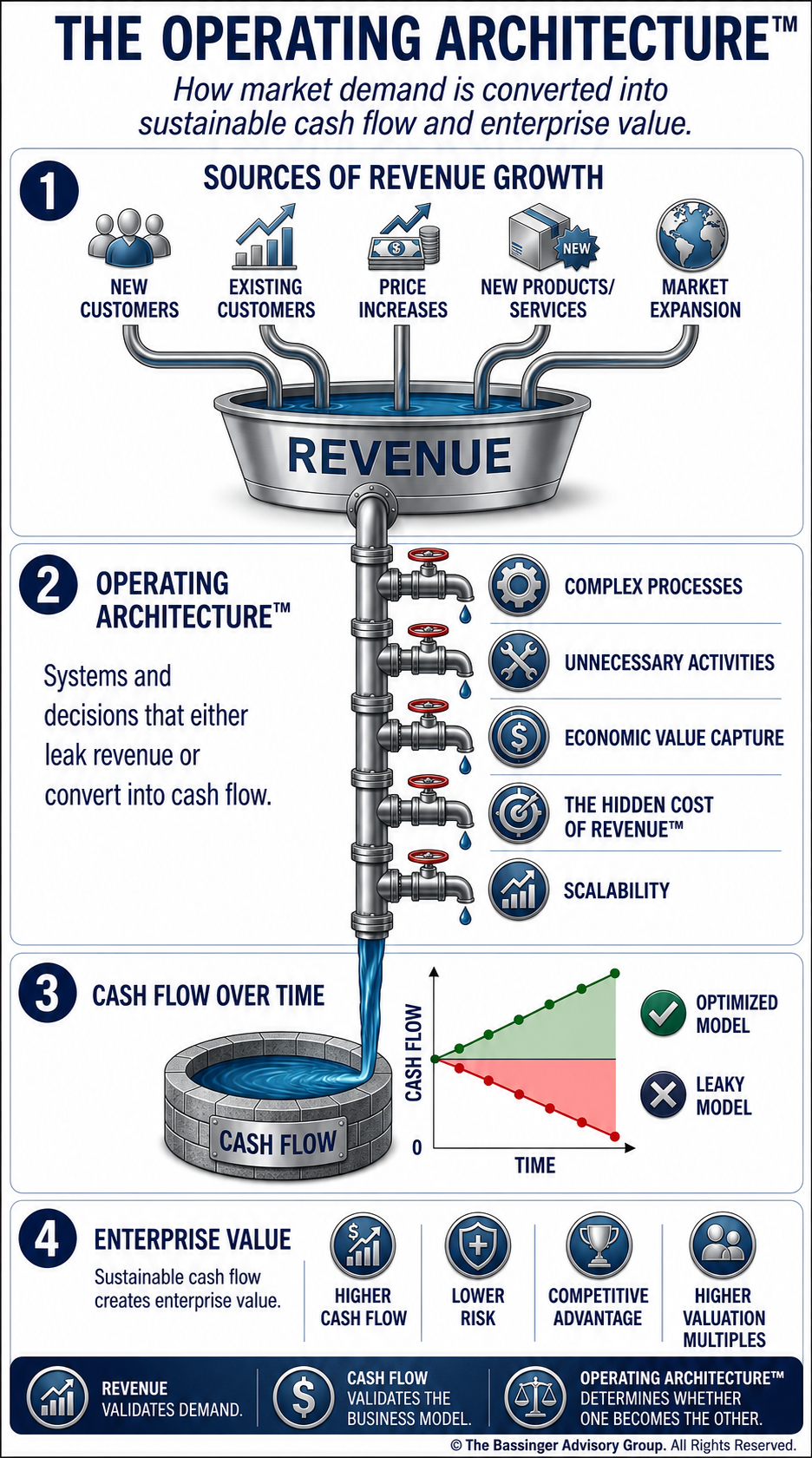
The Value Conversion Model
The model brings the central argument together visually: market demand creates revenue, but the operating architecture determines how much of that revenue leaks away and how much converts into sustainable cash flow and enterprise value.
A Perspective Shaped by Experience
Over the course of my career, I have experienced business from nearly every seat around the table. I have founded and operated four companies, raised more than $1.5 billion in private equity capital for 80+ venture-stage businesses, advised Fortune 500 organizations on product design, manufacturing optimization, and business process reengineering, and served as an investor, consultant, and board member.
That breadth of experience gave me a perspective that no single role could have provided. As a founder and operator, I saw how strategic decisions were translated into day-to-day execution. As an Investment Banker and investor, I evaluated how companies were financed, valued, and positioned for growth. As a consultant and board member, I saw how operating decisions affected performance across functions and over time.
Across industries, markets, and stages of development, one pattern appeared repeatedly: companies rarely struggle because they lack revenue opportunities. They struggle because they attempt to scale operating platforms that were never intentionally designed to support growth.
Early growth often masks inefficiency. Revenue increases. Customers increase. Headcount increases. Capital remains available. The business appears healthy.
Then growth slows. Margins compress. Capital becomes more expensive. Leadership discovers that costs have become embedded throughout the organization.
The very systems that supported growth become obstacles to future growth. The lesson is consistent:
Operating Architecture™: The System Beneath the Scorecard
Financial scorecards show outcomes. Operating Architecture™ explains the system that produced them.
Operating Architecture™ is the system through which a company converts market demand into delivered value, revenue, cash flow, enterprise value, and shareholder returns. It includes the processes, workflows, handoffs, systems, people, approvals, data flows, customer touchpoints, and management routines required to deliver a product or service.
When Operating Architecture™ is clean, intentional, and scalable, growth creates leverage. When it is fragmented, manual, and overly complex, growth creates friction.
Two companies can have similar revenue, similar products, and similar market opportunity, yet generate very different cash flow and enterprise value because their operating architectures are fundamentally different. One converts demand into cash flow efficiently. The other consumes cash trying to manage complexity. That difference is rarely obvious in the early stages of growth. Over time, however, it becomes one of the most important determinants of enterprise value.
The Operating Architecture™ Framework
The Operating Architecture™ Framework provides a practical methodology for evaluating and improving that system. It connects five disciplines:
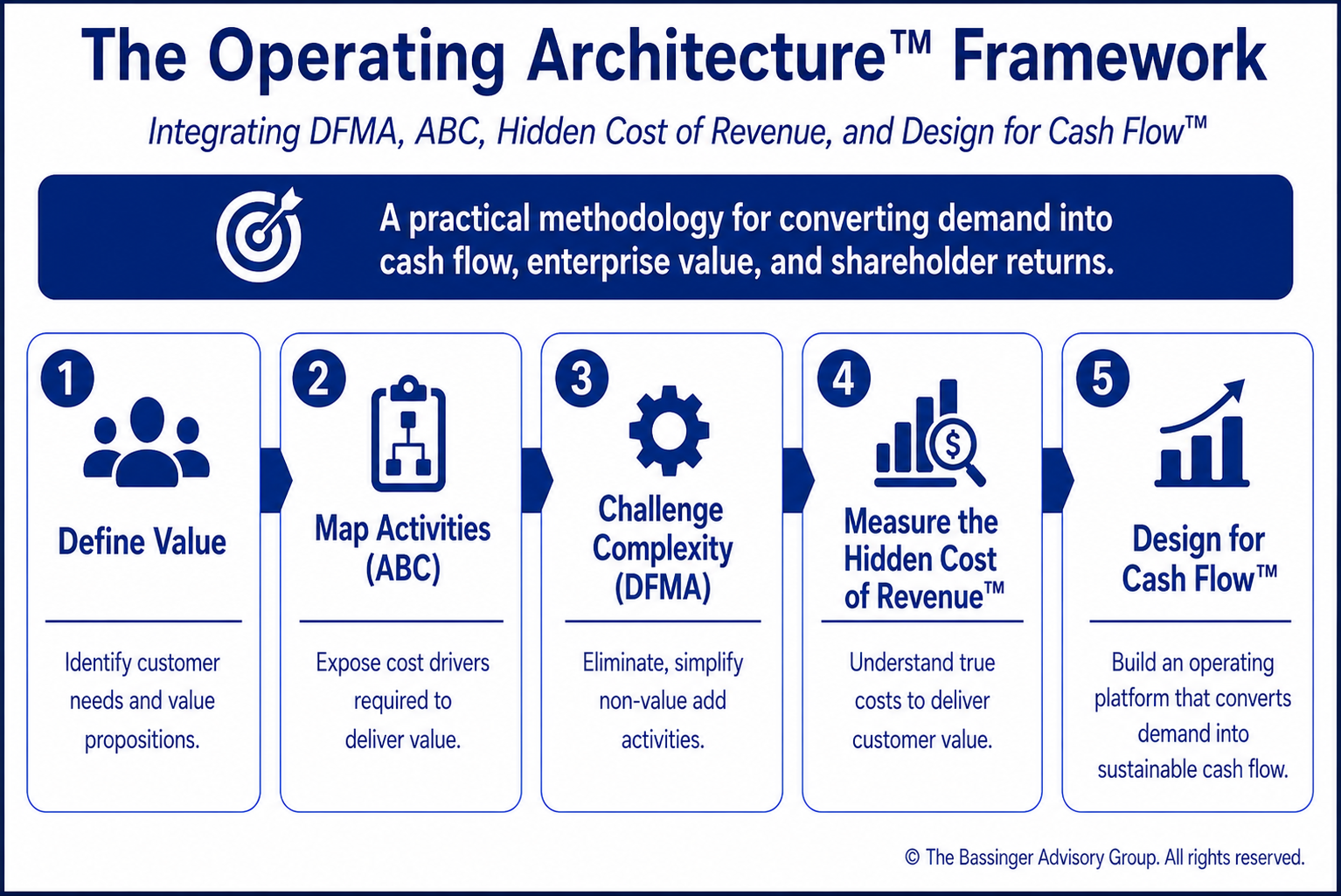
The purpose is not to build a smaller business. The purpose is to build a stronger business.
- A business that converts demand into cash flow more efficiently.
- A business that grows without adding unnecessary complexity.
- A business that improves customer outcomes and expands operating leverage.
- A business that creates sustainable enterprise value and shareholder returns.
What Product Design Taught Me About Business
Long before I entered finance, I worked extensively in high-tech product design and manufacturing environments that utilized Design for Manufacturing and Assembly, commonly known as DFMA. My connection to the discipline began even earlier, as I earned both my Bachelor's and Master's degrees under the founders of DFMA, an experience that deeply influenced how I think about design, efficiency, and complexity.
The discipline was elegant in its simplicity. Every component had to justify its existence. Could it be eliminated? Could it be combined? Could it be simplified?
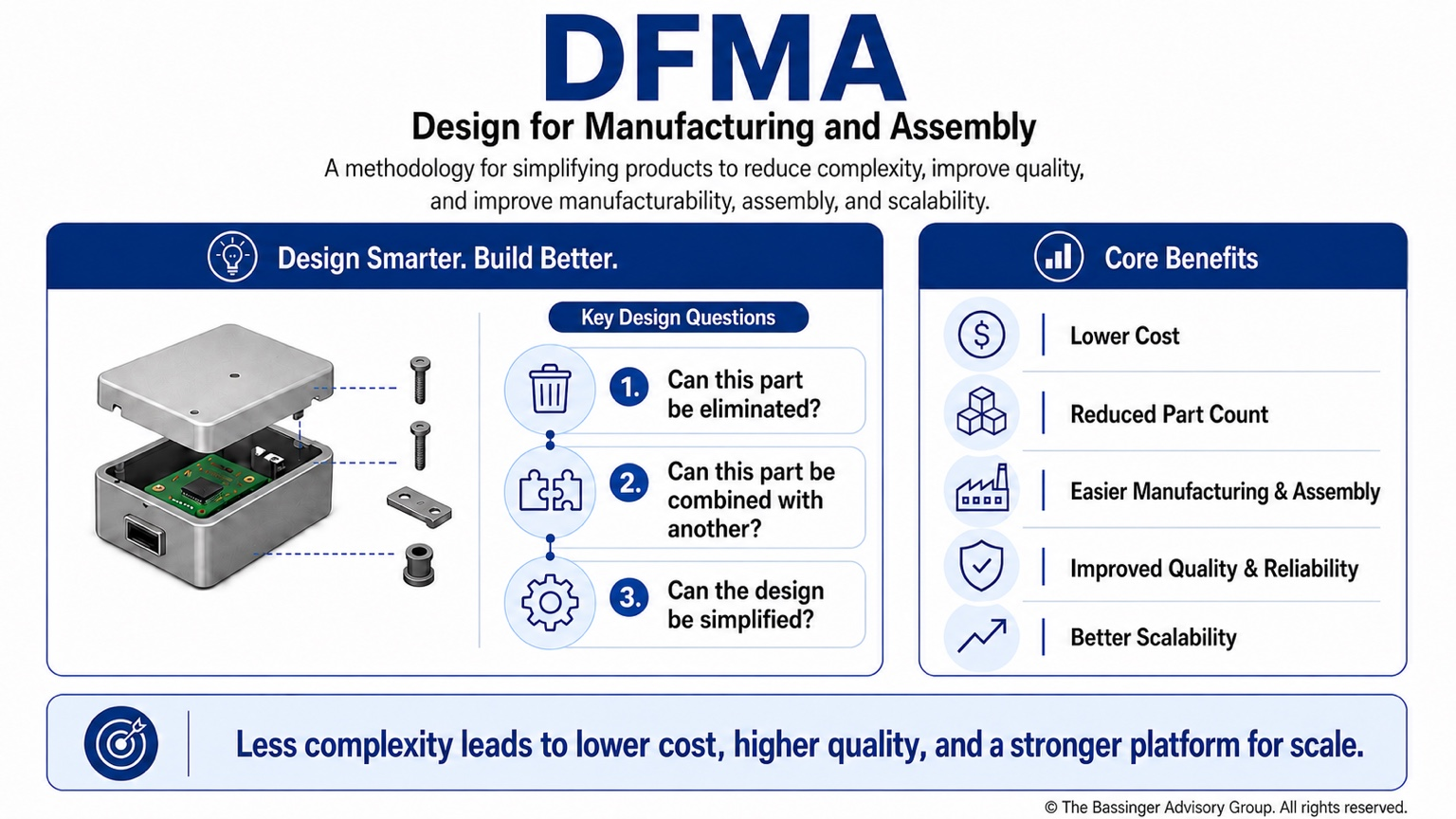
The objective was not simply reducing cost. The objective was reducing manufacturing, assembly, and service complexity. When complexity decreases, manufacturing becomes easier. Quality improves. Costs decline. Scalability increases.
Years later, I realized businesses suffer from the same problem as poorly designed products.
We would never ship a product nobody designed.
Yet most companies operate a business nobody designed.
The effect is remarkably similar. Each additional activity may appear insignificant. Collectively, they create friction throughout the organization.
Over time, that friction becomes embedded in the operating platform, making growth more difficult, more expensive, and less profitable.
The result is organizational weight. And organizational weight is expensive.
Activity-Based Costing: The Diagnostic
One of the most powerful tools I encountered for exposing this complexity was Activity-Based Costing, which played an important role in my years of implementing Business Process Reengineering (BPR) for product and service companies.
Traditional accounting tells us what happened. Activity-Based Costing helps explain why it happened. Rather than focusing solely on departments or expense categories, Activity-Based Costing examines the individual activities that consume resources throughout an organization.
The most significant cost drivers are often not the large, obvious activities. They are the hundreds of small activities embedded within everyday operations.
A process may appear straightforward at a high level. In reality, it may consist of dozens, or even hundreds, of individual actions, handoffs, approvals, communications, file transfers, reviews, rework, and follow-ups.
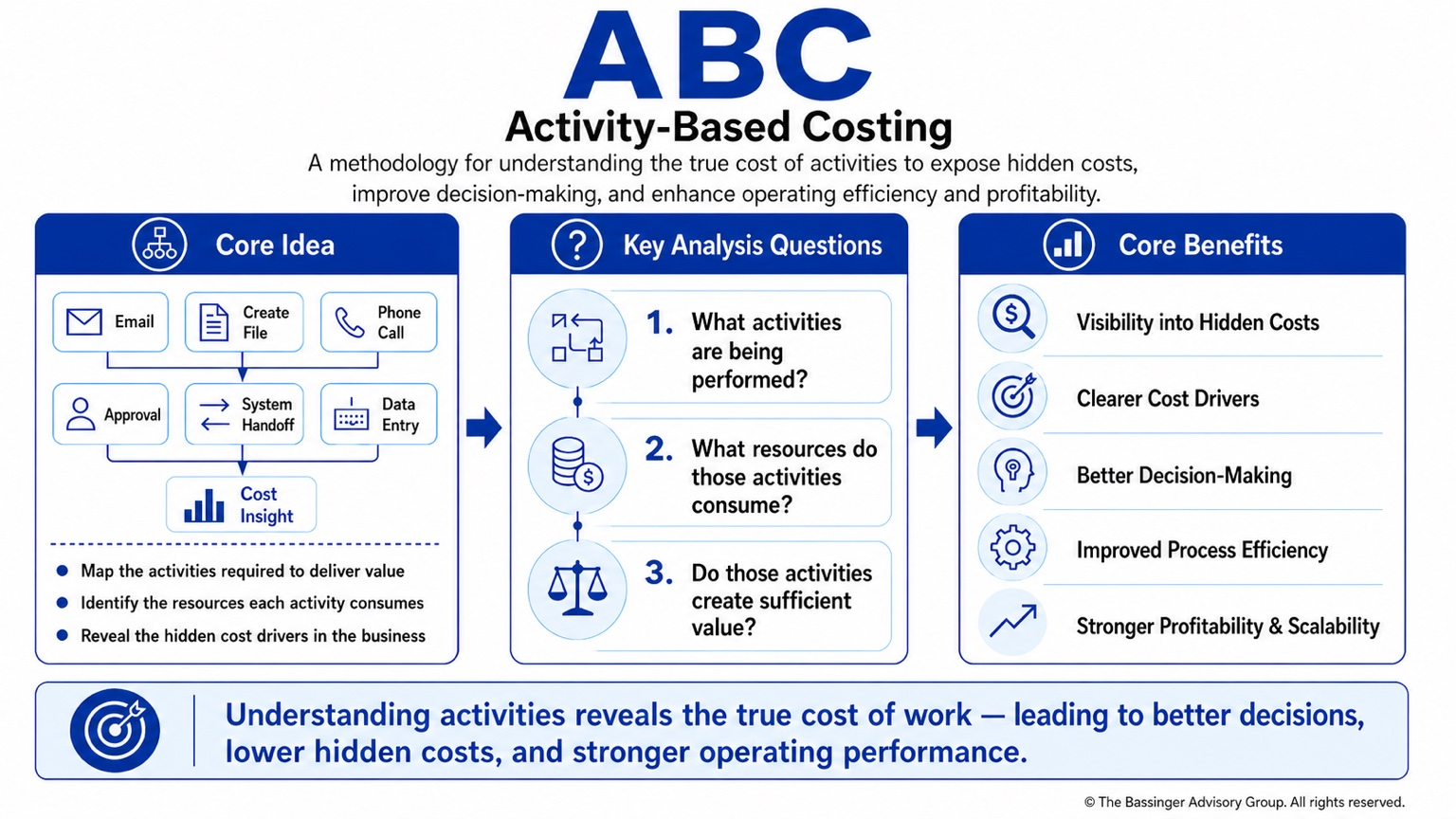
Individually, these activities appear insignificant. Collectively, they become the hidden operating costs that determine whether a company scales efficiently or not.
The objective is not to calculate the cost of picking up a pencil. The objective is to understand every action required to deliver value to a customer.
Once activities become visible, they can be challenged. Once challenged, they can be improved.
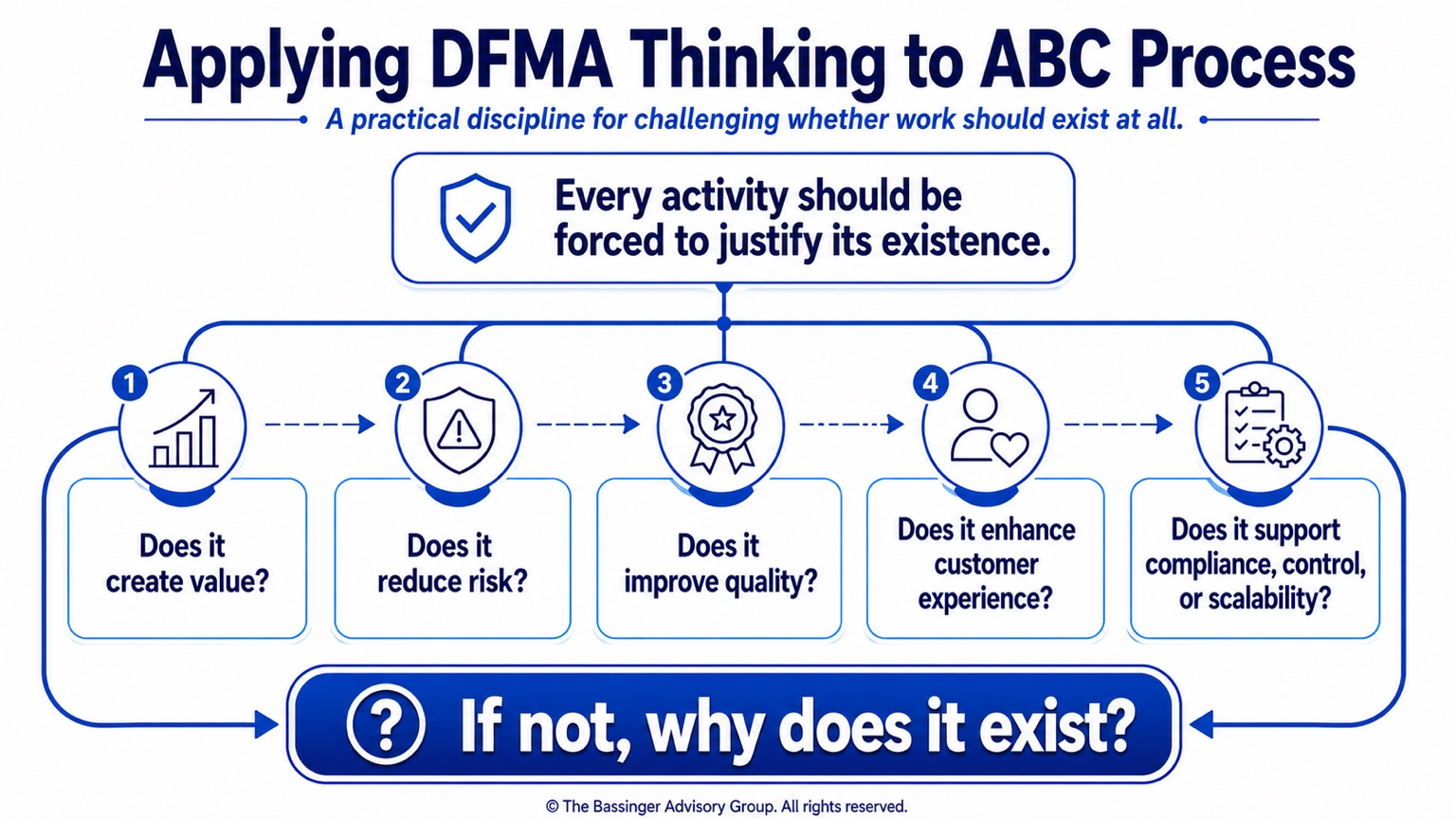
Applying DFMA Thinking to ABC Process Maps
Turning activity visibility into operational simplification
Activity-Based Costing exposes what work is being performed. DFMA thinking challenges whether that work should exist at all. This is where visibility becomes action.
The goal is not indiscriminate cost cutting. The goal is intelligent simplification. Some activities should be eliminated. Some should be combined. Some should be standardized. Some should be automated. Some should be redesigned entirely.
The discipline is to stop accepting inherited processes as permanent operating requirements.
Every activity should be forced to justify its existence. Does it create value? Does it reduce risk? Does it improve quality? Does it enhance the customer experience? If not, why does it exist?
Many companies continue performing activities long after the original reason for those activities has disappeared. Reports continue after no one uses them. Approvals remain after risks change. Manual workarounds become permanent processes. Systems are added without removing the work they were supposed to replace.
How Operating Architecture™ Relates to Business Process Reengineering
Business Process Reengineering was one of the most influential management methodologies of the twentieth century. Introduced by Michael Hammer and James Champy in the early 1990s, it challenged organizations to stop patching inefficient processes and instead redesign them from the ground up. The logic was sound. And in many cases, the results were significant. But BPR had a persistent limitation: while it could redesign how work flowed through an organization, it did not inherently reveal what that work actually cost.
Activity-Based Costing emerged, in part, to fill that gap. DFMA thinking went further still — challenging not just how activities should be performed, but whether they should be performed at all.
The Operating Architecture™ Framework builds on both. But the more significant departure from BPR is one of scope.
BPR asks: How should this process work?
Operating Architecture™ asks: Is this business designed to convert demand into sustainable cash flow at all?
BPR is an important predecessor and a genuine influence. But Operating Architecture™ is not BPR applied to a broader problem. It is a different discipline, informed by different foundations, aimed at a different objective: building businesses that convert demand into durable enterprise value.
Design for Cash Flow™: The Objective
Revenue validates demand. But cash flow validates that the business model works.
A company can have positive net income and still consume cash. A company can have market traction and still destroy value.
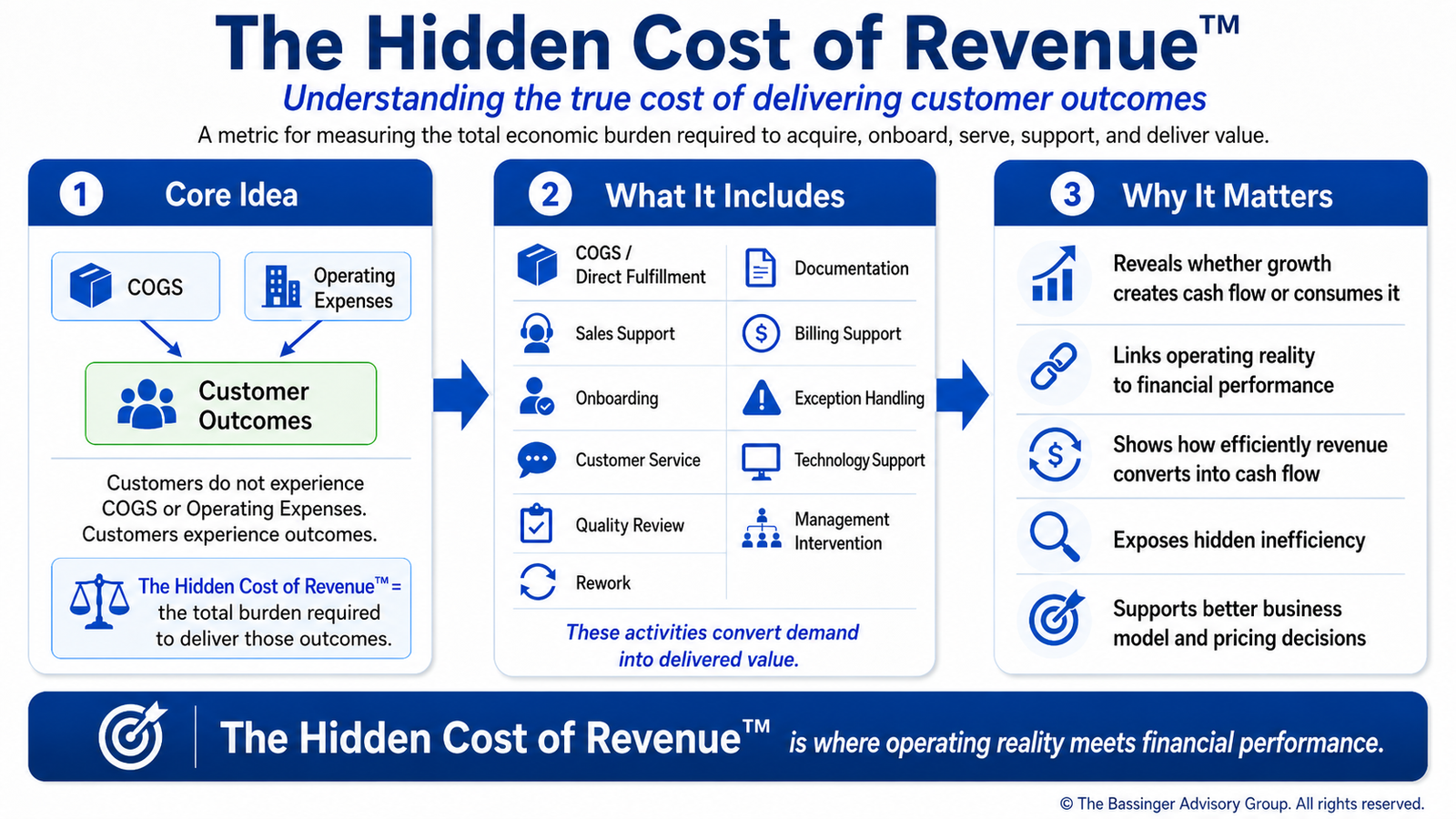
Traditional financial categories such as COGS, operating expenses, gross margin, EBITDA, and net income can each tell part of the story, but none necessarily reveals whether the operating model is efficiently converting demand into cash.
Cash flow reveals the truth.
It shows whether the business can deliver value to customers while generating sufficient economic return to fund growth, support innovation, withstand volatility, and create shareholder value.
That is why cash flow is more than a finance metric. It is an operating outcome. It reflects product-market fit, pricing discipline, delivery efficiency, working capital management, process quality, organizational design, and leadership focus.
That is the purpose of Design for Cash Flow™. The objective is not merely to grow revenue. The objective is to design an operating platform capable of converting revenue into sustainable cash flow as efficiently as possible.
Applying the Framework: A Medical Second-Opinion Company
This medical second-opinion company illustrates how Operating Architecture™ can move beyond operational improvement to business-model redesign.
The company provides access to world-class academic medical second opinions for patients, employers, insurers, and other healthcare stakeholders. Its model is built around helping patients and payors obtain greater clinical clarity in complex medical situations while enabling academic medical centers and reviewing physicians to deliver high-quality second opinions through a structured process.
That created an important operating challenge. The company was not serving a single customer group. It was serving three distinct stakeholders: the patient seeking clarity and confidence, the reviewing physician or academic medical center delivering the second opinion, and the payor seeking better outcomes, better decision-making, and a clearer return on investment.
| The Patient | The Reviewing Physician | The Payor |
|---|---|---|
| Clinical clarity, confidence, understandable guidance, and access to appropriate expertise. | Complete records, a focused clinical question, efficient workflow, and time for medical judgment. | Better decisions, avoidable-cost reduction, predictable economics, and measurable value. |
Each stakeholder had different needs and definitions of value. For that reason, the starting point was not technology, staffing, pricing, or organizational structure. The starting point was understanding the value being delivered to each stakeholder.
Only after defining those value propositions did we examine how value moved through the Operating Architecture™. We mapped the activities required to deliver that value and challenged the operating model through the lens of efficiency, scalability, quality, and customer outcomes.
The objective was not simply to reduce cost. The objective was to create an operating platform capable of supporting sustainable growth while improving The Hidden Cost of Revenue™.
That work created an important strategic opportunity: the ability to disrupt the industry's legacy pricing model.
Historically, many second medical opinion programs have been priced on a Per Member Per Year basis, where customers pay for broad access based on assumed utilization. In many cases, actual utilization is materially lower than the assumptions embedded in the pricing model, causing customers to pay for unused coverage.
By understanding value delivery and actual delivery economics, the company was able to support a more transparent, usage-based pricing model tied directly to the services delivered.
Getting Started: Five Questions to Guide Your Conversation
The Operating Architecture™ Framework is not abstract theory—it is a practical methodology. But it begins not with tools or consultants, but with honest questions about your own business.
Consider these five questions as a starting point:
Question 1: Do you know your true Hidden Cost of Revenue™?
Most organizations can tell you their gross margin or operating expenses. Few can answer what it actually costs to acquire, onboard, serve, and support a customer through the entire lifecycle. This is where most organizations discover their first gap.
Question 2: Could you redesign your business from scratch?
This is the discipline that DFMA brings to manufacturing. If you were designing this business today—without the constraints of legacy systems, inherited processes, or embedded approvals—would you design it the way it currently operates? If the answer is no, you have identified where organizational weight has accumulated.
Question 3: Do your activities create value, reduce risk, or merely exist?
Activity-Based Costing exposes hidden complexity. Spend time mapping a critical process—not at the 10,000-foot level, but at the activity level. List every handoff, approval, communication, review, and exception. Most organizations discover that 30-40% of the activities consumed no one can fully justify.
Question 4: Are you measuring the right outcomes?
Your financial scorecards show what happened. They do not show where friction is building, where value is leaking, or where cash flow is being consumed by complexity. Are you measuring the activities and metrics that predict future cash flow, or only the outcomes that reflect the past?
Question 5: Is your organization built to scale, or to survive?
Early-stage companies often make trade-offs between speed and design. That is reasonable. But if your organization is five years old, $10 million in revenue, or larger, those early trade-offs have probably become embedded. Are you still operating on the architecture that worked when you were smaller? If so, growth is working against you, not for you.
These questions are not meant to be answered quickly or in isolation. They are meant to provoke real conversation across your leadership team—finance, operations, product, customer success, and executive leadership. The insights often emerge not in the questions themselves, but in the disagreement about the answers.
That conversation is the beginning of intentional operating design.
Where Organizations Go Wrong: Common Pitfalls
Operating Architecture™ is straightforward in concept. In practice, organizations often stumble in predictable ways. Understanding these pitfalls can help you avoid them.
Pitfall 1: Treating this as a cost-reduction exercise.
The most dangerous misinterpretation is viewing Operating Architecture™ as a cost-cutting initiative. The purpose is not to build a smaller business—it is to build a stronger one. Sometimes that means adding investment to areas that create value while eliminating activities that don't.
Pitfall 2: Focusing on processes instead of value delivery.
Business optimization can fall into the trap of making processes faster without questioning whether the process should exist at all. Operating Architecture™ begins with value delivery. What outcome are you creating for your customer? What activities actually deliver it? Everything else is waste.
Pitfall 3: Letting perfect be the enemy of progress.
Activity-Based Costing can consume enormous time and resources if pursued to excessive precision. The goal is not to calculate the cost of every minute—it is to understand the cost drivers. Start with high-impact areas and get 80% of the value from 20% of the effort.
Pitfall 4: Underestimating organizational and cultural resistance.
Operating architecture is not just a system—it is a way of thinking. Many organizations impose a new operating model through reorganization or systems implementation without addressing the cultural and cross-functional resistance that emerges. Operations, finance, customer success, and product often have different perspectives on value. This tension is productive—but only if senior leadership is prepared for it, holds people accountable for defending activities, and commits to the belief that intentional design is non-negotiable. Culture change is harder than structure change, and it takes longer.
Pitfall 5: Treating this as a one-time initiative rather than a discipline.
The worst interpretation is approaching Operating Architecture™ as a project to complete and set aside. In reality, it is an ongoing discipline. As your business changes and markets shift, your operating architecture must evolve.
Each of these pitfalls warrants deeper exploration — the subject of upcoming white papers in this series.
Conclusion
Many companies believe scaling means adding more customers, more employees, more systems, and more capital. Sometimes it does.
But sustainable growth rarely comes from adding complexity. More often, it comes from eliminating it.
Every process added without purpose, every workaround made permanent, every approval that outlived its reason — these are the building blocks of organizational weight. And organizational weight is what makes growth more expensive, less predictable, and harder to convert into cash flow.
Capital can temporarily hide inefficiency. Revenue can temporarily mask it. But every business eventually confronts the economics of its operating model — either by design or by crisis.
Financial metrics are essential scorecards. They tell leaders what happened. But they do not, by themselves, reveal where value is being created, where friction is building, or where cash flow is leaking. That work happens beneath the scorecard — in the activities, workflows, handoffs, decisions, costs, and delivery choices that determine whether demand becomes sustainable cash flow.
That is the purpose of the Operating Architecture™ Framework. It is a discipline for understanding how value is delivered, what it truly costs to deliver that value, and how to design a business capable of converting demand into sustainable cash flow.
The companies that create lasting value are not necessarily those that grow the fastest. They are the ones that build operating architectures that convert demand into cash flow efficiently, repeatedly, and sustainably. They build them deliberately, before the economics force the conversation.
Three fundamental truths guide the Operating Architecture™ Framework:
- Your operating model determines your destiny. Revenue growth without operating design is a trap. Scale amplifies whatever works—and whatever doesn't.
- Better operating architecture beats bigger budgets. The companies that win are not those with the most capital or the fastest growth. They're the ones that design systems to convert demand into cash flow efficiently, repeatedly, and sustainably.
- The time to build is before the crisis. Organizations that intentionally architect their operations before growth forces the issue gain years of compounding advantage over those that rebuild under pressure.
The question for your organization is simple but urgent: Is your operating architecture intentionally designed, or simply inherited?
For executives, founders, investors, and boards ready to build the operating architecture your business needs, the conversation starts with a single question: How efficiently is your business converting demand into cash flow?
That conversation is where lasting competitive advantage begins.
About The Bassinger Advisory Group
The Bassinger Advisory Group helps founders, executives, investors, and boards evaluate whether businesses are designed to convert growth into sustainable cash flow and long-term enterprise value. The firm applies the Operating Architecture™ Framework to expose hidden complexity, clarify The Hidden Cost of Revenue™, improve operating leverage, and redesign business models for stronger cash flow conversion.

About Tom Bassinger
Tom Bassinger is the founder of The Bassinger Advisory Group and creator of the Operating Architecture™ Framework.
With experience as a founder, operator, investor, and board member across a wide range of industries and stages of growth, Tom brings a rare vantage point to the challenges of building businesses that scale.
Over the course of a career spanning 35 years, Tom has founded and operated four companies, raised more than $1.5 billion in private equity capital for 80+ venture-stage businesses, and advised Fortune 500 organizations on product design, manufacturing optimization, and business process reengineering.
His work spans corporate development, finance, operations, product design, and customer delivery — a breadth of experience that informs the Operating Architecture™ Framework's integrated approach to building businesses that scale efficiently and generate sustainable cash flow.
Tom holds both a Bachelor's and Master's degree from the University of Rhode Island, where he studied under the founders of Design for Manufacturing and Assembly — a discipline that profoundly shaped his approach to business design and operational efficiency.
Request the Professionally Formatted PDF
A professionally formatted PDF version is available for boards, investors, management teams, academic use, and professional discussion. Please email Tom Bassinger to request a copy.
Request the PDF by Email© 2026 The Bassinger Advisory Group. All rights reserved. Operating Architecture™, The Hidden Cost of Revenue™, and Design for Cash Flow™ are proprietary methodologies and marks of The Bassinger Advisory Group. This material may not be reproduced, distributed, republished, or used to create derivative works without prior written permission. Brief quotations with attribution are permitted for commentary and discussion.